


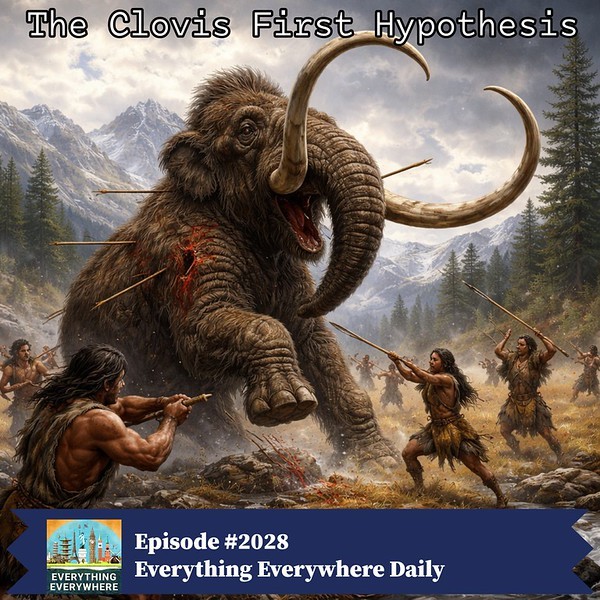
For decades, the story of the first Americans was simple: the “Clovis First” hypothesis claimed that the Clovis people, arriving around 13,000 years ago, were the continent’s original inhabitants. This narrative, built on discoveries like the spear points found alongside mammoth remains in New Mexico in 1932, dominated archaeology for generations. But a growing body of evidence is dismantling that once-unshakeable theory, revealing a much more complex and ancient story of human settlement in the Americas.
The Roots of a Dominant Theory
The Clovis First hypothesis rested on the initial archaeological record. Sites like Blackwater Draw yielded distinctive fluted stone tools associated with extinct megafauna, suggesting a rapid spread of this culture across North America via the Bering land bridge—a now-submerged stretch of land connecting Asia and North America during the last Ice Age. Radiocarbon dating seemed to confirm this timeline, and for years, no other sites convincingly challenged the 13,000-year-old benchmark.
The theory’s longevity wasn’t just about data. A powerful resistance to alternative interpretations emerged. Critics of Clovis First were often dismissed, their findings scrutinized with relentless skepticism. Some researchers even earned the nickname “Clovis-First Police” for their aggressive defense of the established view.
Cracks in the Foundation
The first signs of trouble came with discoveries suggesting human presence before Clovis. Sites like Paisley Caves in Oregon unearthed human fecal matter (coprolites) dating back over 14,000 years, but these findings were initially dismissed due to contamination concerns and questions about artifact authenticity.
Then came Buttermilk Creek in Texas, a site overflowing with pre-Clovis tools buried beneath Clovis artifacts. Despite the compelling evidence, defenders of the old theory attacked every aspect of the dig—soil quality, dating methods, even the integrity of the excavation itself.
South America Strikes Back
The most significant blow came from South America, where the Monte Verde II site in Chile yielded evidence of human habitation dating back nearly 19,000 years. Led by archaeologist James Adovasio, the team found hearths, woven baskets, and tools that defied the Clovis First timeline. Critics claimed the carbon dating was flawed due to coal contamination, but Adovasio’s team presented evidence that even staunch skeptics struggled to refute.
The Final Nails: Wisconsin, Kenosha, and Beyond
Further discoveries continued to pile up. In Wisconsin, a mammoth skeleton with butchering marks dated to 14,500 years ago, and at the Cerutti Mastodon site in San Diego, evidence suggested human activity dating back almost 100,000 years—a claim that remains controversial but has not been disproven. The Bluefish Caves in the Yukon provided further proof, though the site’s champion, Jacques Cinq-Mars, faced funding cuts and attacks from Clovis First advocates.
Finally, Cooper’s Ferry in Idaho sealed the deal. Dating back 16,000 years, the site revealed a distinct tool technology unlike anything seen at Clovis sites, pushing the narrative past its breaking point. Archaeologist Todd Braje declared, “The Clovis-First model is no longer viable.”
Beyond the Land Bridge: The Kelp Highway
If the Bering land bridge wasn’t the sole entry point, how did the first Americans arrive? The emerging theory suggests an alternate route: the “Kelp Highway.” This proposes that early humans navigated the Pacific coast in small boats, following kelp forests teeming with marine life from Japan and Asia. Evidence of Japanese-like spear points near the Channel Islands off California supports this idea.
The challenge is that rising sea levels have submerged most coastal settlements dating back 15,000 years, making direct proof elusive. But the shift in archaeological thinking is undeniable.
A Paradigm Shift
The demise of Clovis First wasn’t about convincing diehards; it was about a generational change. As physicist Max Planck observed, new scientific truths don’t triumph through persuasion but through the attrition of old guard, replaced by those familiar with the updated science.
The story of the Americas’ first inhabitants is no longer a simple one. It’s a tale of resilience, adaptability, and the relentless pursuit of truth in the face of entrenched beliefs. The Clovis First hypothesis may be dead, but the search for our ancestors’ origins continues.


