The American Civil War saw the rise of dedicated prisoner-of-war facilities, and none were more brutal than Camp Sumter, infamously known as Andersonville Prison. This episode explores how a confluence of wartime conditions, political decisions, and systemic failures transformed a hastily built camp into one of the deadliest places in American history. The story of Andersonville is not just about suffering; it’s about the evolution of modern warfare, the collapse of humanitarian norms, and the lasting scars of total conflict.
The Origins of Modern Prisoner Camps
Before the Civil War, capturing enemy soldiers rarely meant long-term imprisonment. Warfare was often seasonal, armies smaller, and mass captivity impractical. Ancient and medieval conflicts saw prisoners killed, enslaved, ransomed, or integrated into the victor’s forces. Even during the 18th and 19th centuries, formal parole and exchange systems were preferred over purpose-built prison camps. The scale and intensity of the Civil War changed everything.
The conflict quickly strained traditional methods. Initially, prisoner exchanges were common, allowing captured soldiers to return to combat relatively quickly. However, by 1863, the Confederacy refused to treat Black and White prisoners equally, arguing that Black soldiers were “property” and should not be exchanged. This decision, coupled with a growing disparity in prisoner numbers favoring the Union, led to the breakdown of the exchange system. Both sides now needed long-term facilities to hold their captives.
The Rise of Andersonville
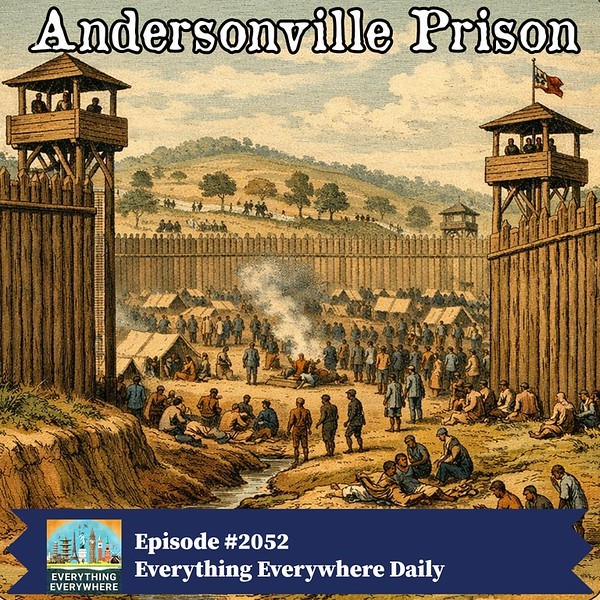
Opened in February 1864, Andersonville was built on 16.5 acres in Sumter County, Georgia. The Confederacy intended it to be a secure holding pen, far from the front lines, but the rapid influx of prisoners soon overwhelmed its capacity. By August of the same year, the camp swelled to 26.5 acres and held over 33,000 men – more than triple its intended size. The stockade was a crude, fifteen-foot-high wall of sharpened logs, with a deadly “deadline” enforced by guards in elevated towers. Crossing the line meant summary execution.
The prison’s location exacerbated the conditions. Built in a swampy area, Andersonville was plagued by disease, filth, and a suffocating stench. The lack of sanitation meant that drinking water and waste disposal shared the same creek, creating a breeding ground for dysentery, typhoid, and scurvy. Prisoners were emaciated, infested with lice, and forced to scavenge for scraps or steal from the dead to survive.
Lawlessness Within the Walls
The breakdown of order within Andersonville was as brutal as the external conditions. The camp fractured into rival factions: the Raiders, a gang of thieves who preyed on weaker prisoners, and the Regulators, who formed their own vigilante justice system to counter them. The Regulators held mock trials, meting out punishments ranging from flogging to hanging. This internal conflict added another layer of horror to an already hellish environment.
Desperate prisoners attempted escapes through tunnels, but most were too weak to succeed. Others feigned death, hoping to be overlooked during the daily removal of corpses. Guards eventually caught on, forcing surgeons to verify bodies before disposal.
The Collapse of Accountability
The conditions at Andersonville were so catastrophic that Commander Henry Wirz eventually paroled five prisoners, petitioning for the reinstatement of prisoner exchanges. The Confederacy refused, and the camp remained a death trap until Sherman’s March to the Sea began to disrupt the South’s logistics in late 1864. By the time Union forces liberated Andersonville in May 1865, over 13,000 prisoners had died – a staggering 13% fatality rate.
After the war, the United States sought accountability. Wirz was tried and convicted of war crimes, becoming the only Confederate official executed for his role in the prison’s horrors. His trial remains controversial, with some arguing that he was scapegoated for systemic failures higher up the chain of command.
A Lasting Legacy
The survivors of Andersonville returned to a nation forever changed by its brutality. The camp was converted into Andersonville National Cemetery, where former prisoner Dorence Atwater and nurse Clara Barton meticulously marked the graves of the fallen. Of the 13,000 who died, only 460 remain unidentified to this day.
Andersonville stands as a grim reminder of the limits of wartime morality. While prisoner-of-war camps were a relatively new concept, Lincoln had demanded laws to protect prisoners from enslavement, torture, and murder. The Confederacy ignored these standards, allowing Andersonville to become one of the most horrific atrocities of the Civil War. The camp’s legacy underscores the devastating consequences of unchecked cruelty, indifference, and the breakdown of basic human decency in the face of total conflict.