


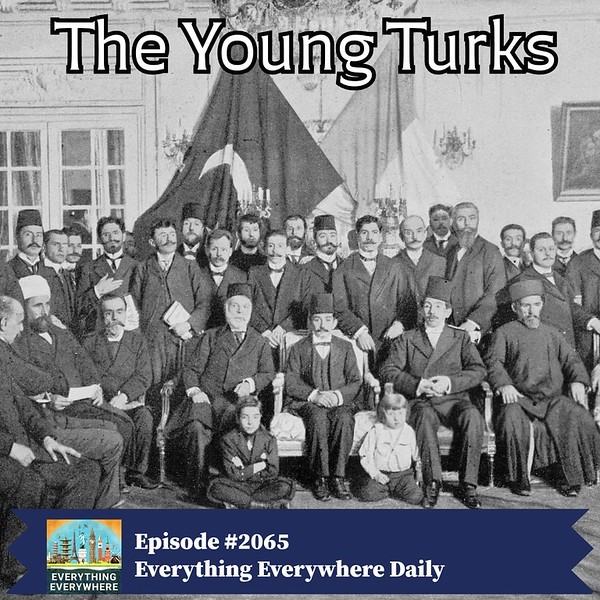
The late 19th and early 20th centuries saw the Ottoman Empire, once a global power, teetering on the brink of collapse. Dubbed the “sick man of Europe,” the empire’s inability to adapt to modernizing forces in Europe led to economic ruin, territorial losses, and internal unrest. From this decay emerged a group known as the Young Turks, initially driven by a desire to modernize Turkey, but whose path ultimately led to radical nationalism and unimaginable tragedy.
The Ottoman Decline and the First Reforms
By the 1800s, the Ottoman Empire faced mounting pressures from European powers eager for economic control. In 1838, the Treaty of Balta Liman effectively turned the empire into a British free-trade zone, stripping it of economic sovereignty. Further humiliation came with the Crimean War (1853-1856), where European intervention prevented Russia from dismantling the already weakened Ottoman state.
To counter this decline, the Ottomans initiated the Tanzimat Reforms, aiming to modernize along European lines: establishing secular education, reforming legal systems, and securing rights for Ottoman subjects. However, these reforms met resistance from both conservative religious leaders and a growing sense that they merely reinforced European control.
The Emergence of the Young Turks
The most vocal critics of the Tanzimat Reforms were the Young Ottomans, who advocated for a more inclusive form of citizenship rather than continued subjugation under imperial rule. In 1876, they led a constitutional revolution, briefly installing a parliamentary government. But this experiment in democracy was short-lived. Sultan Abdul Hamid II swiftly suspended the constitution and ruled as an autocrat, despite some progressive policies.
The Young Turks, a more radical faction, formed in exile in Paris. They sought not just reform but a complete overhaul of the Ottoman state, embracing universal suffrage, legal equality, religious freedom, and even the emancipation of women – a concept unheard of in the traditional Ottoman world. This last point was particularly radical, as they believed women were essential for building a new Turkish future.
Coup and the Rise of Turkish Nationalism
Unable to effect change from abroad, the Young Turks seized power in a 1908 coup, forcing Abdul Hamid II to reinstate the constitution. By 1909, they had dethroned him and replaced him with a more pliable successor, Mehmed V. With the new Sultan in place, they began implementing their platform, secularizing institutions and promoting Turkish as the official language.
This last move proved critical. The Ottoman Empire was a mosaic of ethnicities and languages, and prioritizing Turkish fueled the rise of Turkish nationalism at the expense of other groups. A militant faction, the Committee for Union and Progress (CUP), seized control, advocating for a unified Turkish state stretching from the Bosporus to Central Asia.
The Armenian Genocide
The shift to Turkish nationalism had brutal consequences. The most devastating example is the Armenian Genocide. The CUP, led by the Three Pashas – Talaat, Enver, and Djemal – blamed Armenians for Ottoman defeats in the Balkan Wars and World War I. They accused them of disloyalty and collaboration with Russia, where a significant Armenian population resided.
In 1915, the Ottoman government enacted the Dispatchment and Settlement Law, enabling the mass deportation of Armenians. Over the following years, hundreds of thousands were systematically murdered through forced marches, starvation, and direct killings. Eyewitness accounts from the era detail horrific atrocities, including mass executions, rapes, and the destruction of Armenian churches.
Estimates of the death toll vary, with the Turkish government claiming around 300,000 deaths while Armenian sources cite 1.5 million. The Turkish government maintains that the deaths were a consequence of wartime conditions rather than systematic genocide, a claim widely disputed by historians.
The End of the Young Turks and Legacy
The Young Turk regime collapsed after the Ottoman Empire’s defeat in World War I. The Three Pashas fled into exile, where they were hunted down by Armenian avengers as part of Operation Nemesis. Two were assassinated, while the third died fighting Russian communists in Central Asia.
In 1923, the Ottoman Empire dissolved, replaced by the Republic of Turkey under Mustafa Kemal Atatürk. Atatürk continued many of the Young Turks’ modernization reforms, but without the same brutality. The Young Turk movement, born of ambition and modernization, ended in tragedy, leaving a legacy of nationalism, violence, and denial.
The Young Turks began with dreams of progress; they ended with three men fleeing on a submarine into the night.


