
Central Ireland holds secrets that most visitors zooming between Dublin and Galway completely miss. That is a shame. Offaly, a quiet county in Leinster, is far more than just a stopover. It is a landscape of peat bogs, ancient stone forts, and rivers that have carved their way through history for millennia. If you are planning a trip here, you need to know where to look and why it matters.
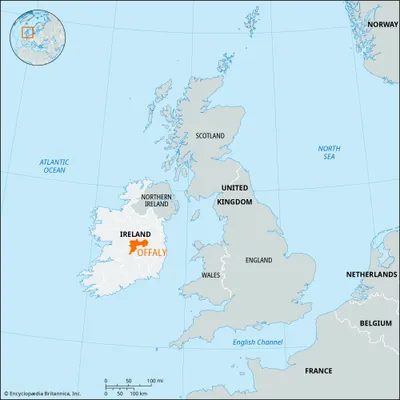
The geography is distinct. You will find the county bounded by Westmeath and Meath to the north, Kildare to the east, Laoighis and Tipperary to the south, and Galway and Roscommon to the west. The River Shannon acts as a natural western border, slow and wide, defining the edge of the province.
Tullamore sits right in the middle of this expanse. It serves as the county town and a practical hub for travelers. But looking at a map won’t tell you what the land actually feels like.
Why Offaly’s Landscape Is Unique
The terrain is a mix of the flat and the rugged. Most of the county is part of the central lowlands, but head southwest and you hit the Slieve Bloom Mountains. The crest of these mountains forms a distinct boundary.
The ground itself is interesting. You are walking on glacial drift and peat bogs. These bogs are not just wet ground. They are historical archives. Dig deep enough and you find evidence of human activity going back thousands of years.
“A notable geologic feature is the fine series of eskers… notably at Clonmacnoise.”
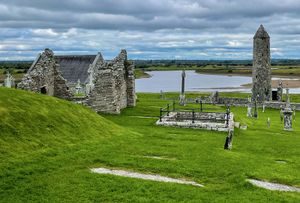
Eskers are long ridges of gravel left behind by retreating glaciers. They cut through the bogs like raised highways. Clonmacnoise is the best place to see them. This ancient monastic site sits near the Shannon. The eskers there are particularly fine, offering dry ground where the water once reigned.
Where to Find Ancient History
You do not need a PhD to spot the past here. It is written in the earth.
Offaly is dotted with raths. These are prehistoric hill forts. They are circular enclosures that once protected settlements. You will also find a chain of mottes. These are artificial mounds, often topped with wooden towers in medieval times. They were built to command the passes through the bogs. Control the pass, control the movement.
Remains of ancient churches and monasteries are scattered across the countryside. They sit in silence. The stone is worn by wind and rain. Yet they stand.
How to Get Around Offaly
Logistics matter. You want to move freely.
Tullamore is your anchor. It sits on a branch railway line running from Athlone to Portarlington. Trains are not frequent, but they are real. You can use them to hop between towns.
For heavier cargo, the Grand Canal still carries goods. It is a slow way to travel, but it connects Offaly to the wider network of Irish waterways. If you enjoy walking or cycling, the canal paths are excellent. They offer flat, scenic routes away from traffic.
What to See in Offaly: The Clonmacnoise Connection
Most travelers asking about Offaly want to know about Clonmacnoise
Beyond the Big Cities: Rural Ireland’s Quiet Charm
Most of the county’s people aren’t in the capital. They’re scattered across villages and smaller towns. Tullamore is the main hub here. It’s where you’ll find the bulk of the services and the steady rhythm of daily life. But the real magic is in the quieter spots. Edenderry sits nearby. Then there is Birr.
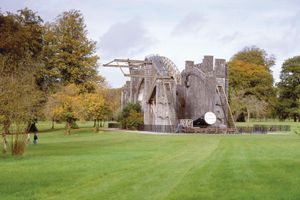
Birr is worth the detour. Just look up. A massive telescope from the 1840s still dominates the sky there. It’s a relic of scientific ambition. You can actually see it. It’s not just a fact in a book. It’s a physical anchor in a landscape that often feels too empty for such grand engineering.
The scale of the area is hard to grasp until you drive it. 773 square miles. That is 2,001 square kilometers of rolling terrain. It’s wide enough to hide secrets. Narrow enough to miss them if you aren’t paying attention.
The population tells a story of slow growth. In 2006, there were 70,868 people. By 2011, that number climbed to 76,687. The 2022 census put it at 83,150. It’s not booming. It’s steady. People stay. They move in slowly. They put down roots in places that don’t demand constant noise.
Why do travelers skip this? Because it’s not on the main loop. But that’s exactly why it’s worth visiting. You get space. You get history that isn’t buried under souvenir shops. You get a view of Ireland that isn’t postcard-perfect but is genuinely lived-in.
Check the times for the telescope site. It’s not open 24/7. Plan for a half-day in Birr alone. Then head to Tullamore for dinner. The costs are lower than in the cities. The food is simpler. The pace is slower.
You might wonder if it’s too quiet. It is. For three hours. Then the silence starts to feel like a luxury.