Sniff. Swirl. Sip.
My eyebrows go up. It is genuinely complex. A sixty-forty mix of Western Cape shiraz and cabernet, hitting all the warming spices and dark cherry notes that make you forget where you actually are.
I am in Cape Town. But not at a winery framed by those screensaver-perfect mountain backdrops. Nor am I in some polished, upscale bistro in Camps Bay pretending I belong there. Instead, I am sitting on a plastic chair against buttercream walls, tucked behind a chaotic mix of formal housing and makeshift structures in Khayelitsha township.
Twenty miles from the city center. A place that grew out of apartheid-era zoning laws designed to house non-white workers. Two million people live there. Or at least that’s the rumor, since official census data tends to undercount.
Khayelitsha is off the tourist radar. Which makes this tasting session feel like an act of rebellion. The wine, served by Finest Wines Khayelitsha (KFW), is arguably better than what I drank in the expensive districts.
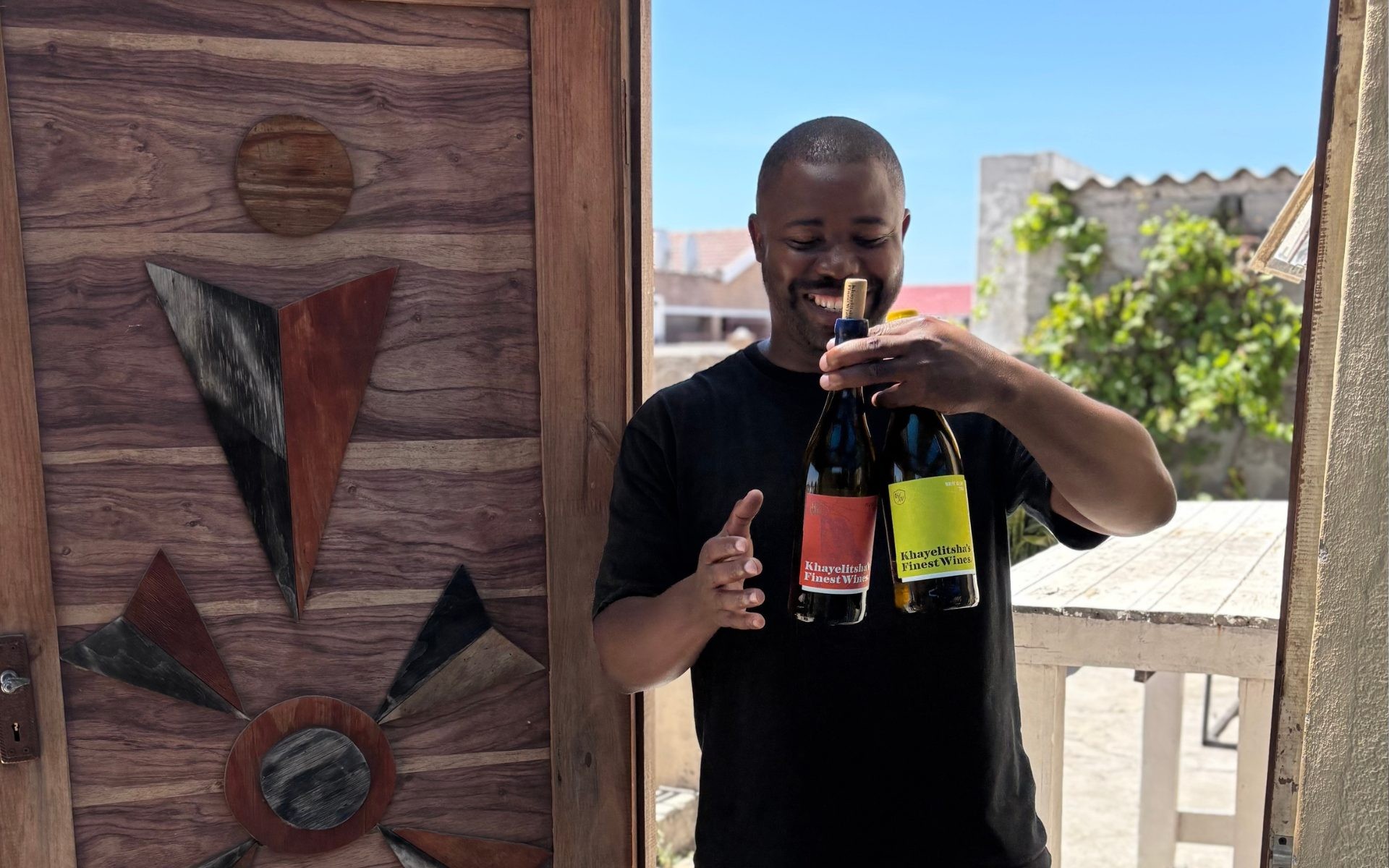
Under a makeshift canopy of corrugated metal, Lindile Ndzaba pours a white blend. Chenin blanc, mostly, with touches of sémillon and sauvignon. His labels look sophisticated. They sit comfortably beside vintages at COY and Salsify, two of the city’s fanciest restaurants. But Ndzaba isn’t just playing the role of a typical wine supplier.
He has a mission.
“Wine consumed here… had to be diluted with soda because it was unpalatable,” Ndzaba tells me. “I wanted conscious consumption. Moving away from just getting drunk.”
He started KFW in 2015 to bridge the gap. Historically, wine culture has walled people like Ndzaba out. The industry excluded township residents, treating them as labor, not participants.
“I wanted to create something relatable for outsiders,” he says. “Pride in where we’re from matters.”
This isn’t subtle. The branding screams Khayelitsha. The bottle labels feature actual maps of the township. At tastings, Ndzaba doesn’t pair his vintages with imported cheese or fancy charcuterie. He pairs them with tripe. He pairs them with umleqwa ne dombol (wild chicken and dumplings).
He wants to break the rule that wine requires European accompaniments. Good wine needs good food, period.
Ndzaba knows the hospitality grind. Like most township youths who make it to the city, he started in a kitchen. He worked front-of-house. He watched the sommeliers work.
“It taught me the ecosystem isn’t just about drinking alcohol,” he explains. “It’s about soil, climate, geography.”
The Western Cape is huge. Fifty thousand square miles of steep slopes and valleys that shift from rust red to deep green. He fell in love with the terroir. He wanted to understand how soil translates to glass.
But Khayelitsha doesn’t have vineyards. So he sources grapes from Stellenbosch partners. He uses their infrastructure to blend his own wines. He acts as the curator. The negotiator. The bridge.
It’s a slow fight. Black South Africans dominate the service workforce but rarely own the land. Only two-and-a-half percent of vineyards are black-owned. Apartheid left deep scars, dividing ownership along rigid racial lines that refuse to heal quickly.
“Wine feels intimidating here,” Ndzaba admits. “People don’t feel they belong. You can’t have conversations if you were never taught the language.”
To fix that, KFW partners with ABCD Concepts, a local tour company. Founders Buntu Matole and Aynda Cuba lead visitors into the township. It’s ethical tourism. Locally driven. Locally led.
I’ll admit, I was hesitant at first. Township tours often veer into “human zoo” voyeurism. It can feel unethical to treat poverty like an attraction.
But Matole showed me the other side. I ate creamy white samp (umngqusho omhlep ) at Spine Road Lifestyle. I forked into tender beef stew. I watched women grill meat on street-side fires.
As a Black visitor myself, being there felt necessary. Essential, even.
A larger shift is happening, too. Places like The Wine Arc in Stellenbosch and Nkula in Cape Town’s center are amplifying black-owned labels.
“There’s a movement supporting local black founders,” Ndzaba says. “These spaces let us validate our ambitions.”
He is part of a rising generation of producers. Take M’hudi, founded by the Rangaka family when they became the first black owners of a SA wine farm in 2003. Look at Aslina, launched by Ntsiki Biyela, the first black woman winemaker in SA. Consider Tembela Wines, led by Khayelitsha native Banele Vake. There is Amandla, led by Praisy Dlamini. I even saw Amandla sitting on shelves at a supermarket in London.
“Things are changing,” Ndzaba notes. “A new wave is diversifying the scene.”
But he keeps it grounded. This progress didn’t happen overnight. Older generations paved the road.
Still, the gap is massive. South Africa is over eighty percent black, yet black-owned brands claim less than three percent of wine sales. Access to capital remains a major barrier. Emerging labels need investment to scale up inventory and market share. Ndzaba needs money to build bigger stocks. Without it, he stays small.
But he isn’t discouraged. He watches the data. The sales velocity is climbing. People are buying with intent. Consumers increasingly seek out brands that reflect social values.
I finish the last swallow of my red blend. It has a finish that lingers, energetic and bright.
Tracing the map on the label, I see what he’s doing. He isn’t just selling wine. He is redrawing the mental map of the country. Khayelitsha exists. It belongs.
And he’s putting it exactly where it deserves to be.