Singapore Airlines (SIA) has announced a significant delay in its highly anticipated premium cabin retrofit program. Originally scheduled to debut in the second quarter of 2026, the first aircraft featuring the airline’s new first and business class products will now not enter service until the first quarter of 2027.
This setback affects a massive SGD 1.1 billion (~USD 835 million) investment designed to modernize the interiors of SIA’s entire long-haul Airbus A350-900 fleet. The delay is attributed to widespread industry supply chain constraints and certification hurdles for new seating hardware—issues that have become increasingly common across the aviation sector.
Despite the timeline shift, the scope of the upgrade remains ambitious. The project involves reconfiguring 41 aircraft, including seven A350-900 Ultra Long Range (ULR) jets, to introduce a new first-class suite, an upgraded business class, and enhanced connectivity via Starlink Wi-Fi.
A Strategic Fleet Transformation
The retrofit program is not merely an aesthetic refresh; it represents a strategic alignment of SIA’s premium offerings across its future fleet. The new cabin products developed for the A350-900s are designed to be identical to those that will eventually debut on the carrier’s future Boeing 777-9 aircraft.
This synchronization is crucial for SIA. With Boeing’s 777-9 deliveries repeatedly pushed back—now not expected before 2027—SIA has chosen to bring its “flagship” cabin experience to its existing A350 fleet rather than waiting for new aircraft that may not arrive for another decade.
Key Changes by Aircraft Type
The reconfiguration alters seat counts and class availability depending on the specific variant of the A350-900:
-
Standard Long-Haul A350-900s:
- Current: 253 seats (42 Business, 24 Premium Economy, 187 Economy).
- Future: 258 seats (42 Business, 24 Premium Economy, 192 Economy ).
- Note: Capacity remains stable in premium cabins, while economy class gains five seats.
-
Ultra Long Range (ULR) A350-900s:
- Current: 161 seats (67 Business, 94 Premium Economy).
- Future: 132 seats (4 First, 70 Business, 58 Premium Economy ).
- Note: This variant introduces a boutique First Class cabin with just four seats. To accommodate this luxury tier, Premium Economy capacity is significantly reduced by 36 seats, while Business Class gains three seats.
Excluded from this retrofit are the A350-900s configured for regional flights, which currently share cabin layouts with the Boeing 787-10.
New Premium Products: What to Expect
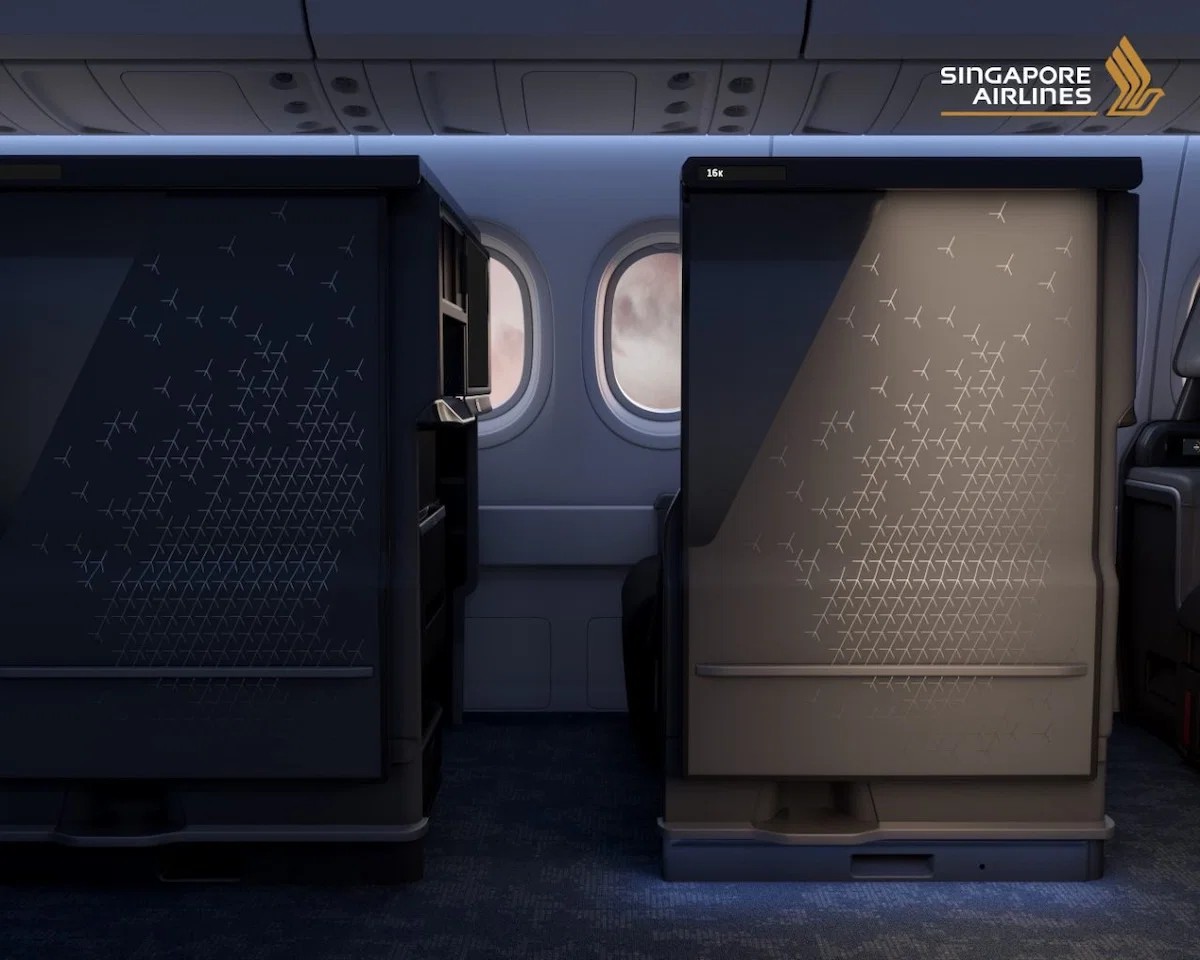
The core of this investment lies in the introduction of new hard products for First and Business Class. These are intended to be SIA’s long-term premium standards, replacing older configurations that have been in service for years.
The New First Class Experience
First Class is currently limited to SIA’s Airbus A380 and Boeing 777-300ER fleets. The new A350-900ULR configuration will expand access to this tier, albeit in a very exclusive format.
- Layout: Based on filed patents for the 777-9, the cabin is expected to feature a 1-2-1 configuration. This includes individual suites along the windows and a convertible double suite in the center.
- Flexibility: The central suite can operate as a private space for one passenger or open up for two, offering flexibility for couples or solo travelers seeking extra width.
- Comparison: While luxurious, this layout contrasts with competitors like Japan Airlines and Emirates, who are introducing 1-1-1 configurations (fully private suites for every passenger) on their long-haul routes. However, SIA’s design prioritizes social flexibility for pairs, a niche not fully addressed by the stricter 1-1-1 models.
The New Business Class
SIA’s current business class product, while service-led, has been viewed by some industry observers as aging in terms of hardware. The new product promises:
* Enhanced Privacy: High privacy doors, similar to leading competitors.
* Staggered Configuration: Likely a staggered seat layout to maximize space and comfort.
* Potential Platform: Industry speculation suggests the seats may be based on the Safran Unity platform, known for its comfort and used by carriers like Japan Airlines.
Why the Delay?
The pushback from Q2 2026 to Q1 2027 highlights two persistent challenges in modern aviation:
- Supply Chain Constraints: Global shortages of specialized components have slowed production and retrofitting timelines across the industry.
- Certification Hurdles: New seating designs require rigorous safety certification. Delays in this process are common when airlines introduce complex, custom-built suites.
The retrofitting work will be performed by SIA Engineering Company in Singapore. Despite the delay, the airline maintains that the entire fleet retrofitting project is still expected to be completed by the end of 2030.
Conclusion
Singapore Airlines’ decision to delay its cabin overhaul reflects the broader operational realities facing global carriers today. While passengers must wait longer for the debut of these new premium experiences, the strategic move to install future-proof cabins on existing A350s ensures SIA remains competitive with top-tier rivals until the Boeing 777-9 finally arrives.
Key Takeaway: The first retrofitted A350-900 will enter service in Q1 2027. The upgrade introduces a boutique 4-seat First Class on ULR routes and a modernized Business Class across the fleet, addressing long-standing hardware gaps despite industry-wide supply chain delays.