Located just 90 minutes south of Brussels, the town of Hastière is often overshadowed by its architectural jewel, the Saint-Pierre Abbey. While the Romanesque abbey draws tourists for its historical grandeur, the banks of the Meuse River nearby tell a different, equally compelling story: one of industrial ingenuity and the relentless battle against nature.
The Meuse has long been Belgium’s economic lifeline. Since gaining independence in 1830, the young nation recognized that controlling this turbulent river was essential for transporting stone from local quarries and timber from surrounding forests. This infrastructure was not merely about local logistics; it was the backbone of trade with the Netherlands to the north and France to the south. To tame the Meuse, engineers in the 19th century embarked on a massive modernization project, installing 15 weirs along the river’s length from the French to the Dutch border.
The Challenge of a Wild River
Modernizing the Meuse was not simply a matter of building static dams. The river is notoriously volatile, prone to annual floods that sweep massive amounts of debris—dead wood and rocks—downstream. A rigid structure would have been destroyed instantly. Therefore, the weirs had to be movable.
Engineers faced a critical design challenge: how to maintain water levels for navigation while ensuring the structures could be rapidly dismantled or lowered during floods to prevent catastrophic failure. The solution lay in two distinct, ingenious mechanical systems that defined 19th-century hydraulic engineering.
Two Ingenious Solutions
To manage the river’s unpredictability, engineers developed two primary types of movable weirs. In many locations, including the historic site at Hastière, these were combined into “mixed weirs,” utilizing both technologies simultaneously to maximize control and safety.
1. The Needle Dam (Poirée Weir)
Designed in 1834 by French engineer Antoine Poirée, this system relied on simplicity and modularity.
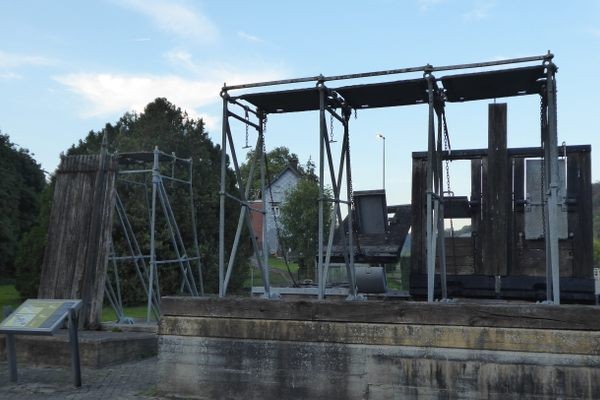
* Structure: It consisted of long wooden poles (needles) slotted into a metal framework.
* Operation: If a floating object, such as a log, approached, workers could remove individual poles to let it pass, then replace them.
* Flood Protocol: During high water, the entire set of poles was removed, and the metal framework was laid flat on the riverbed, perpendicular to the current, minimizing resistance.
2. The Wicket Dam (Chanoine Weir)
Invented around 1850 by French engineer Jacques Henri Chanoine, this system offered more nuanced control over water flow.
* Structure: It used a series of vertical planks supported by a metal frame. Each plank featured a “wicket”—a small opening that allowed controlled water passage.
* Operation: The dam could be adjusted in four ways depending on flow rates:
1. Plank raised (blocking flow).
2. Plank raised with the sluice gate open.
3. Plank angled to allow water to pass over and under.
4. Plank laid flat on the riverbed.
* Flood Protocol: Like the needle dam, the support structure could be flattened onto the riverbed during floods, but aligned with the direction of the current.
A Rare Glimpse into the Past
These mechanical marvels have largely vanished from the modern landscape. Today, the Meuse in Belgium is regulated by large, automated movable gates that require little human intervention. The era of manual pole-removal and plank-adjustment ended with the last operational combined weir at Hastière, which ceased service in 1983.
However, Hastière remains unique. It is the only location in Belgium where preserved sections of both the Poirée needle dam and the Chanoine wicket dam can be seen together. These remnants stand near the Hastière lock, accompanied by information panels that decode their complex mechanics.
Why This Matters
The preservation of these weirs is more than a nod to nostalgia; it is a testament to the evolution of human adaptation to natural forces. Before the age of automation and heavy concrete, engineers relied on clever, reversible mechanics to coexist with a powerful river.
The Hastière site serves as an open-air museum of hydraulic history, illustrating how 19th-century innovation balanced economic necessity with environmental reality.
For visitors, walking these banks offers a rare opportunity to visualize the industrial heritage that shaped modern Belgium. It reminds us that behind today’s seamless river transport lies a history of trial, error, and brilliant mechanical design.
In summary, the preserved weirs at Hastière are not just relics; they are tangible evidence of the engineering ingenuity that turned a wild, dangerous river into a vital corridor of commerce, marking a pivotal chapter in Belgium’s industrial history.