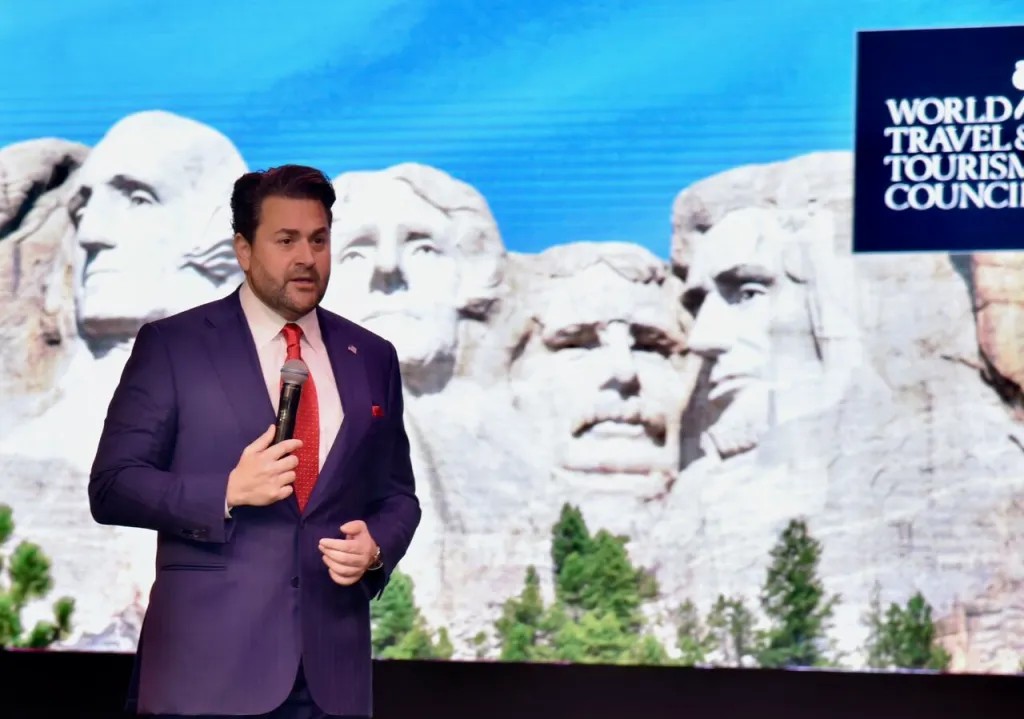
Nick Adams, the newly appointed Special Presidential Envoy for American Tourism, Exceptionalism and Values, has made it clear that he intends to break with diplomatic tradition. In his first major international appearance since taking office in March, Adams delivered a keynote address at the World Travel and Tourism Council’s (WTTC) leadership summit in Egypt that was defined by its volume, provocation, and directness.
Adams, a conservative commentator and author who became a U.S. citizen in 2021, rejected the cautious tone typically associated with global tourism diplomacy. Instead, he positioned himself as an aggressive advocate for the American brand, aiming to counter negative narratives about the country’s openness.
A Departure from Traditional Diplomacy
Walking onto the stage to the sound of Michael Jackson’s Thriller, Adams immediately set a confrontational yet energetic tone. He warned delegates that he was not there to engage in subtle statecraft.
“I am not a traditional diplomat. I am here to make noise, for America and for the industry,” Adams told the audience.
His message was twofold: first, to assert that America remains a welcoming destination for visitors; and second, to aggressively dismiss critics who suggest otherwise. Adams characterized those who portray the U.S. as unwelcoming as being “full of it,” signaling a strategy built on defiance rather than conciliation.
Context and Implications
The appointment of Adams marks a significant shift in how the Trump administration is approaching international tourism promotion. By selecting a figure known for his outspoken conservative commentary rather than a career diplomat or industry veteran, the administration appears to be prioritizing ideological alignment and high-visibility messaging over traditional soft-power tactics.
This approach raises questions about the effectiveness of such a polarizing strategy in a global market. While the goal is to project confidence and dispel misconceptions about travel to the U.S., the aggressive rhetoric may also alienate potential visitors who prefer a more neutral or welcoming diplomatic engagement. The move reflects a broader trend in the administration’s foreign policy: favoring direct, often combative communication over established diplomatic norms.
Conclusion
Nick Adams’s debut on the global stage signals a new, louder era for American tourism promotion. By rejecting traditional diplomacy in favor of a confrontational narrative, the Trump administration is testing whether aggressive advocacy can effectively reshape international perceptions of the United States as a travel destination.