While much of the aviation industry focuses on the “solo traveler” experience—prioritizing privacy, individual pods, and personal space—this trend often leaves couples and families at a disadvantage. As airlines redesign their cabins to maximize efficiency and privacy, the ability to interact with travel companions is frequently sacrificed.
For those traveling with a partner or a child, the choice of airline and seat configuration can be the difference between a restful flight and a logistical challenge.
The Pitfall of the Solo-Centric Design
Modern airline trends are heavily leaning toward reverse herringbone layouts and highly privatized suites. While these are excellent for individual productivity and sleep, they present significant hurdles for groups:
- The Privacy Paradox: Seats like those found on Starlux’s A350 or various new “pod” configurations are designed to isolate the passenger. In these layouts, even if you sit in adjacent center seats, you often have to lean forward significantly just to hold a conversation.
- The “Choice” Gap: New cabins, such as the Lufthansa Allegris or SWISS Senses, offer a variety of seat types. However, if a couple wants to sit together, they are often restricted to specific, premium-priced front-row suites, as the standard configurations prioritize individual boundaries.
- Parenting Challenges: For those traveling with toddlers, these isolated pods can be difficult to manage. Navigating a small child in a seat that is physically separated from your companion makes monitoring and assistance much harder.
The Gold Standard: “Honeymoon” and Staggered Configurations
If your priority is connection—whether that means sharing a conversation with a partner or keeping an eye on a child—the staggered configuration is the superior choice. Specifically, look for airlines that offer “honeymoon” seats.
These are layouts where certain rows allow two seats to be positioned much closer together than a standard cabin allows.
Top Performers for Connection:
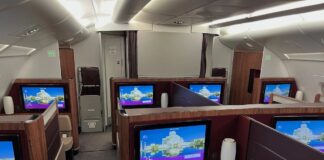
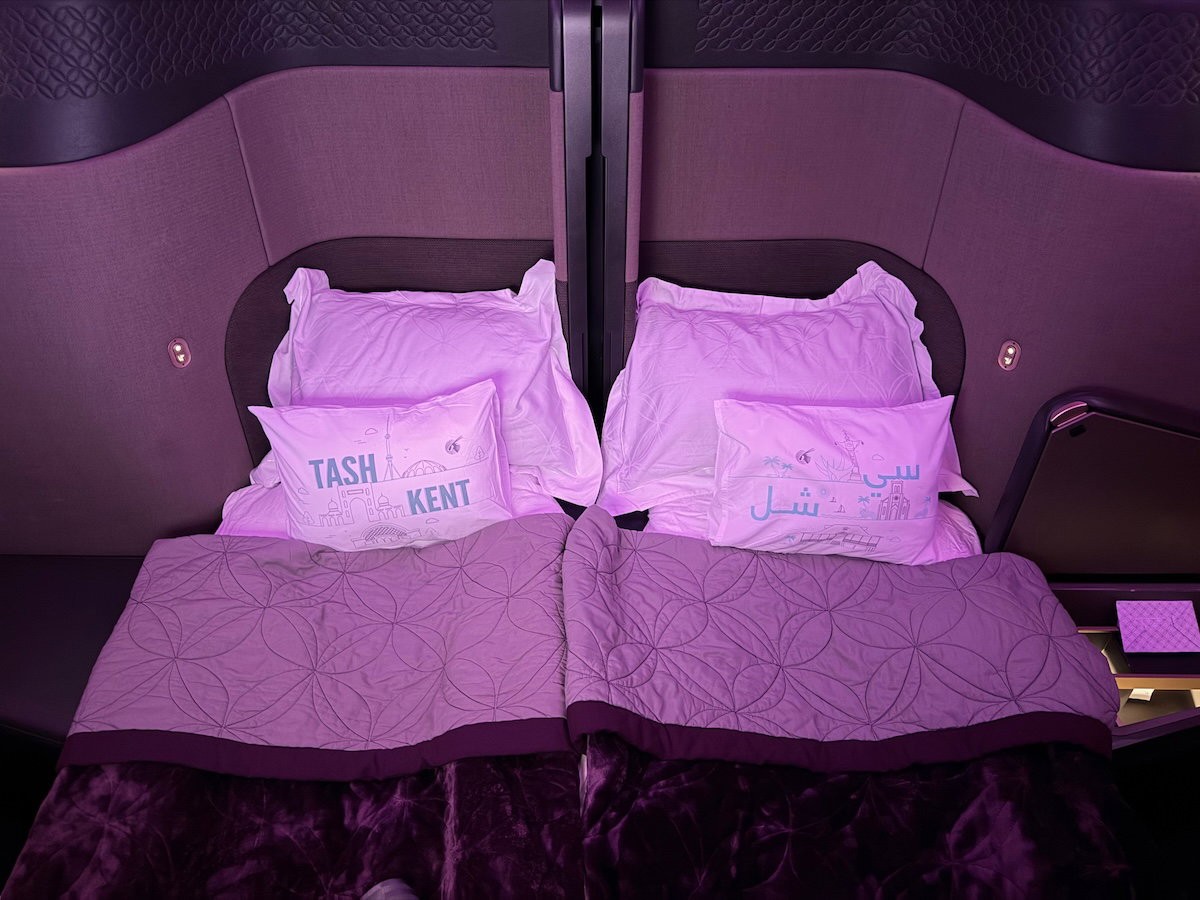
- Qatar Airways (Qsuites): Widely considered the industry leader for groups. Qsuites allow pairs to create a double bed, and they even offer a “quad” configuration where four seats can be combined into a private social space.
- ANA (The Room): On their Boeing 777 fleet, ANA offers massive, spacious staggered seats that allow for high levels of interaction without sacrificing the luxury of the hard product.
- Other Notable Mentions: Airlines such as Etihad (787), Condor (A330-900neo), and Korean Air (787-10) also utilize these staggered layouts that facilitate togetherness.
When “Old” is Better: The Value of Traditional Layouts
Interestingly, some older or more densely packed seat designs actually outperform modern luxury pods when traveling in a group.
- Lufthansa’s legacy business class and Turkish Airlines’ A330/777 layouts often feature pairs of seats that allow travelers to sit side-by-side.
- The Collins Aerospace Diamond product (seen on airlines like Ethiopian Airlines’ A350 ) is often criticized by solo travelers for being “dense,” but for a couple or a family, this density translates to proximity and shared experience.
Summary of Selection Strategy
Choosing the right business class seat requires a shift in perspective based on your passenger manifest:
- Traveling Solo? Prioritize reverse herringbone or private pods for maximum sleep and isolation.
- Traveling as a Couple? Prioritize staggered “honeymoon” configurations to allow for shared meals and conversation.
- Traveling with Young Children? Avoid isolated pods at all costs; seek out side-by-side seating or configurations that allow you to remain within arm’s reach of your child.
Conclusion: The “best” business class seat is subjective; while solo travelers crave isolation, couples and families should hunt for staggered layouts that prioritize proximity over privacy.