
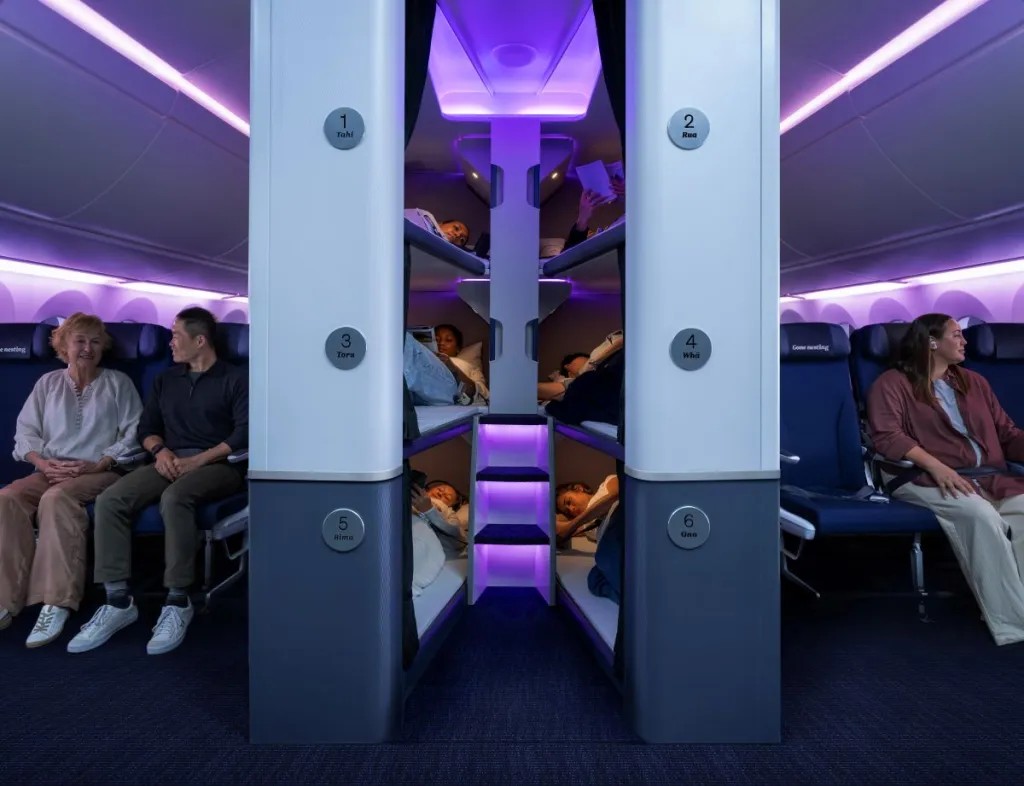
After years of concept designs and industry speculation, the dream of sleeping flat in economy class is moving closer to reality. Air New Zealand has officially announced that its “Skynest” concept—a series of bunk-style sleeping pods—will be available for purchase starting May 18.
From Concept to Cabin
The Skynest is not a complete overhaul of the economy cabin, but rather a strategic addition. The system consists of six bunk-style pods positioned in the transitional space between the Economy and Premium Economy cabins.
While the technology has been in development since early 2020, the global pandemic significantly delayed the rollout. Now, the airline is prepared to move from prototype to commercial service, marking a significant shift in how long-haul economy travel is structured.
Targeting the Ultra-Long-Haul Market
The rollout strategy focuses on the most demanding routes in the sky. The first commercial flights featuring the Skynest are scheduled for November, operating on the route between Auckland and New York (JFK).
This specific route was chosen for several strategic reasons:
– Extreme Duration: The flight exceeds 17 hours, making it one of the longest nonstop journeys in the world.
– Physical Toll: Long-haul travel at this scale often results in extreme fatigue and “jet lag exhaustion” for passengers.
– Market Differentiation: By offering a middle ground between a standard economy seat and a premium economy seat, Air New Zealand is targeting travelers who want better rest without the high cost of a business class lie-flat bed.
Why This Matters for the Aviation Industry
The introduction of the Skynest highlights a growing trend in aviation: the “premiumization” of economy class. As airlines face rising costs and intense competition, they are looking for creative ways to squeeze extra value out of existing cabin space.
For years, the “flat-bed” experience was a luxury reserved exclusively for Business Class. By utilizing the “dead space” between cabins to install bunk pods, airlines can offer a hybrid product. This addresses a specific pain point for travelers—the inability to sleep on long flights—while providing the airline with a new, high-margin revenue stream.
The Skynest represents a clever use of cabin architecture to solve a fundamental problem of ultra-long-haul travel: human fatigue.