
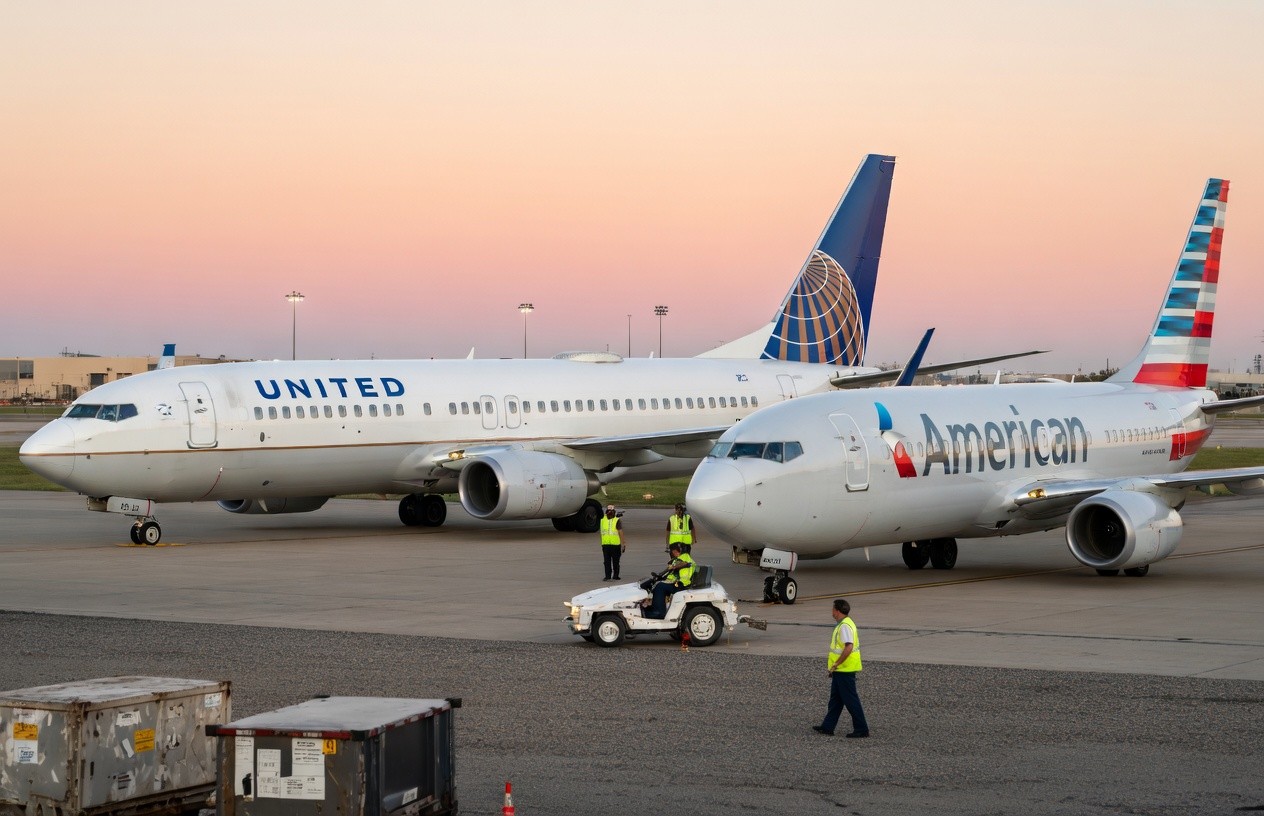
A potential merger between United Airlines and American Airlines is facing a formidable obstacle: the threat of future legal warfare. A progressive coalition in the U.S. House of Representatives, known as the “Monopoly Busters Caucus,” has signaled that even if the Trump administration approves such a deal, a subsequent Democratic administration could move to dismantle it.
This tension highlights a critical reality in antitrust law: a merger approved today does not grant permanent immunity from scrutiny tomorrow.
The “Monopoly Busters” Strategy
The Monopoly Busters Caucus—a group of 19 left-leaning lawmakers including Alexandria Ocasio-Cortez, Rashida Tlaib, and Pramila Jayapal —is positioning itself to challenge any massive consolidation in the aviation sector.
Their strategy rests on a key legal principle: the Department of Justice (DOJ) does not grant permanent “immunity” through silence. If the DOJ reviews a merger under the Hart-Scott-Rodino Act and chooses not to act, it does not mean the deal is “cleared” forever. If a completed merger is later found to violate antitrust laws, the DOJ (or state attorneys general) retains the power to sue to unwind the deal and force the divestiture of assets.
The Domestic Impact: Market Dominance and Divestitures
A combination of United and American would be unprecedented in scale, controlling approximately 40% of domestic U.S. flight capacity. This level of market power creates several immediate regulatory headaches:
- The “Tunney Act” Requirement: To prevent endless litigation, the DOJ would likely need a formal “consent judgment” under the Tunney Act. This requires a court to rule that the merger is in the public interest. Without this, a future administration could argue the deal was flawed from the start.
- The Domino Effect on Partnerships: A merger of this size would likely force the dissolution of existing alliances. For example, American Airlines’ partnership with Alaska Airlines would almost certainly be scrutinized or broken to prevent a domestic monopoly.
- Hub Vulnerability: To satisfy regulators, the new entity might be forced to give up prime real estate, such as gates in Los Angeles or significant capacity at Chicago O’Hare (a potential windfall for Delta Air Lines).
A Global Regulatory Nightmare
The complexity of this deal extends far beyond U.S. borders. Because airlines operate through intricate “joint ventures” (alliances that allow them to coordinate schedules and revenue), a United-American merger would trigger a global chain reaction of reviews:
✈️ Europe and the UK
The UK government and the EU would scrutinize how the merger affects competition at major hubs like London Heathrow. Currently, British Airways (via IAG) dominates Heathrow; a United-American alliance could disrupt this balance, forcing the new carrier to surrender valuable “slots” (landing rights) to maintain competition.
✈️ The Pacific and Oceania
- Japan: Both carriers have major joint ventures (American with Japan Airlines; United with ANA). A merger would force a choice between these alliances, potentially impacting access to the highly contested Haneda Airport.
- Australia/New Zealand: The merger would force a reconfiguration of existing ties with Qantas and Air New Zealand, giving those governments significant leverage to demand concessions.
✈️ The Americas
- Brazil: As a major player in South American routes, American Airlines’ merger would require approval from Brazilian regulators, who would examine the impact on local carriers like Gol and Azul.
- Canada & Mexico: Transborder flight capacities would be re-evaluated, potentially turning aviation policy into a tool for broader diplomatic negotiations.
Conclusion
The proposed United-American merger represents more than just a business deal; it is a geopolitical and legal lightning rod. Even if the deal secures federal approval in Washington, it faces a “nightmare” of international regulatory hurdles and the persistent threat of being dismantled by future administrations seeking to curb market dominance.