Munich has a reputation for being Germany’s leisure capital. Locals will tell you that the city itself offers everything you need. You can rent a bike. You can skate. You can sit under a chestnut tree in the English Garden with a liter of beer. But eventually. You always want more. The pull toward the countryside is strong. It is inevitable.
Escape to the Starnberger See
If you want to leave the urban sprawl, go south. That is where the good stuff is. Mountains. Lakes. Castles. The direction is clear. The options are endless. For a quick reset, Starnberger See is the answer.
It is close. A half-hour drive gets you to the north shore. The S-Bahn is faster and more relaxing. You can bring your bike. The lake stretches 27 kilometers long and five kilometers wide. It is big enough to feel vast but small enough to circle if you are fit. Most people just pick a spot.
Where to Sit and Swim
Luxury seekers head to the Starnberger Seepromenade. Sit on the wooden terrace of Undosa. Watch the boats. It is expensive. It is posh. It works.
Prefer tradition? Drive or bike to Ambach on the east shore. Eat fish. The Gasthaus zum Fischmeister serves clever dishes that justify the trip. Nearby, you find designated recreation areas. The views of the Alps are constant. They never get old.
History and Roses
Possenhofen on the west bank offers a different vibe. Culture. History. Empress Elisabeth of Austria, known as Sissi, spent her summers here. Her palace sits ten minutes from the shore. You can walk from the water’s edge to the historic site. Just below the palace, there is a swimming spot called “Das Paradies” (Paradise). The name says it all.
A little further south, roughly thirty minutes away, lies the Roseninsel. The Island of Roses. This is where Sissi met King Ludwig II. The setting is romantic. The history is heavy.
For something else entirely, head to Bernried. The Buchheim Museum der Phantasie sits right on the park by the lake. It houses Günther Buchheim’s Expressionist collection. The exhibits change. The park does not.
Why Go South?
Why do people leave Munich? Because the city is loud. The south is quiet. The water cools you down. The air is cleaner. You leave with a sense of space. You return with stories.
The logistics are simple. Take the train. Rent a bike. Walk. The infrastructure is built for this. It is not a hike into the unknown. It is a short hop.
Which route do you choose? The luxury promenade? The historic castle? Or the rose island? The lake does not care. It just waits.
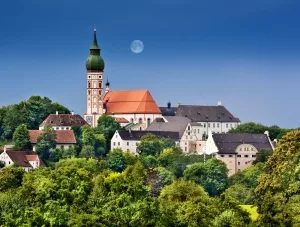
Skip the museums for an hour. Trade the gallery walls for mountain air. If your soul is weary from high culture, head west toward the Ammersee. The destination isn’t just a lake; it’s Andechs.
This is the “Holy Mountain” of Bavaria. It’s a Benedictine abbey, the oldest pilgrimage site in the state, and arguably the best brewery in the region all rolled into one steep climb.
The Climb and the Craft
You don’t get to the top by magic. You get there by walking. The path up is well-marked but demanding. Expect a solid hike if you aren’t used to elevation. The payoff, however, is immediate once you pass the monastery gates.
The architecture is Baroque perfection. White walls against a blue sky. Gold accents catching the sun. But the real draw for most visitors isn’t the stained glass. It’s the beer.
Andechs Monastery Brewery has been brewing since the 15th century. The beer is rich, dark, and heavy on the malt. It tastes like history. You can tour the facilities if you book ahead, but the real experience happens in the beer garden below.
The Andechser Bräustüberl Rules
Here is the trick. The rules here are ancient, enforced with a smile.
Bring your own bread and snacks.
It’s called Brotzeit. You carry your own food. You don’t buy it there. You buy the beer from the tap. A Maß, or a liter of that dark, velvety lager, sits heavy in a glass mug. It pairs perfectly with whatever cheese, sausage, or bread you hauled up the hill.
If you forgot your basket? Don’t panic. The kitchen serves warm and cold Schmankerl (delicacies). They have food. But the ritual of the Brotzeit is part of the charm. It slows you down. It forces you to sit.
On Sundays, if the weather holds, there is brass music. Blasmusi. Live bands playing traditional tunes. The sound drifts down from the terrace. It’s not background noise. It’s an event.
The View: Dach der Republik
Once you’re fed and watered, look up. Or better yet, climb further.
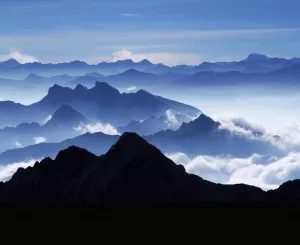
The monastery sits on a ridge that offers panoramic views of the Alps. The Wetterstein range stands stark against the horizon. The Zugspitze, Germany’s highest peak, is visible on clear days. It’s why people call this the “Roof of the Republic.”
The clouds often sit below you. You feel detached from the ordinary world. The air is thinner here. Colder.
Practical Logistics for the Traveler
- Getting There: Take the S-Bahn from Munich to Herrsching or Andechs station. From there, it’s a 20-30 minute walk uphill. Do not drive if you plan to drink. Parking is limited and far from the beer garden.
- Cost: Beer is expensive for Germany. Expect to pay €4.50–€6.00 per Maß. Food, if bought there, is pricey but high quality. Bring snacks to keep costs down.
- Timing:
Beyond the Zugspitze: High-Altitude Views and Alpine Access
If the Heilige Berg feels too modest, Germany’s highest point is just a short hop away. The Zugspitze sits at 2,962 meters. It is the roof of the country. Most locals in Munich do not trek up here on a random Tuesday. They treat it as a weekend escape only when the weather is clear. For visitors, it is mandatory. You can hike it over three days. Or take the gondola if you dislike heights. The cog railway also works. It runs through tunnels but offers sharp views of the emerald-green Eibsee. The viewpoint near the summit delivers a breathless panorama. If you want to hike without the altitude, try the Hausberge Wank or Eckbauer instead. Also, crime fans who enjoy dark humor should read Jörg Maurer’s novels set in Garmisch. They capture the eerie atmosphere of the resort perfectly.
How to reach Garmisch and Linderhof
Transport logistics matter here. Take the train from Munich Hauptbahnhof to Garmisch. It takes ninety minutes. Driving is faster. It saves about thirty minutes. But only if you avoid the traffic. Everyone thinks of Oberau at the same time. The jams are predictable. Leave early. Return early. Or stay for dinner. Wait out the rush hour before heading back to the city. If you drive, stop at König-Ludwig-Schloss Linderhof in Ettal. It is a worthy detour.
Tegernsee, Schliersee, and the Wendelstein route
The next leg of the journey involves two lakes and one major peak. Take the A8 toward Salzburg. Then cut across the land to Tegernsee, Schliersee, and Wendelstein. Alternatively, use the BOB (Bayerische Oberland-Bahn). It stops at every key location. Once there, let the landscape dictate your pace.
Serious runners circle the Schliersee. Hikers climb to Schliersbergalm. Those in Rottach-Egern head to Moni-Alm via the Tegernsee. Mountain bikers have endless routes to burn energy.
For a gentler ascent, ride the cable car up Wendelstein. Locals call it “Haltestelle zum Bayernhimmel.” It is a fitting name. An observatory sits at the top. So does a weather station. A geopark traces 250 million years of earth history across four trails. Imagine the Wendelstein as a coral reef off North Africa’s coast. The geology is starkly different from what you see today.
Drivers or fit cyclists can tackle the pass road to Spitzingsee. From there, walk or ride into the Valepp valley. Stop at the historic Forsthaus Valepp. Order venison, roe deer, or chamois from the local reserve. The game is fresh. The flavor is intense.
If you prefer to stay below the peaks but still crave mountain air, end the day at Café Winklstüberl in Fischbachau. The coffee machine collection exceeds 600 units. The cake counter is legendary. The slices are massive.
The motto for escaping Munich is simple: smell the lake air, lace up your boots, absorb the mountains, and eat well.
You cannot go wrong with this plan. Bavarians may have many stereotypes. But they know how to enjoy life. Almost as well as Italians with their Dolce Vita.