
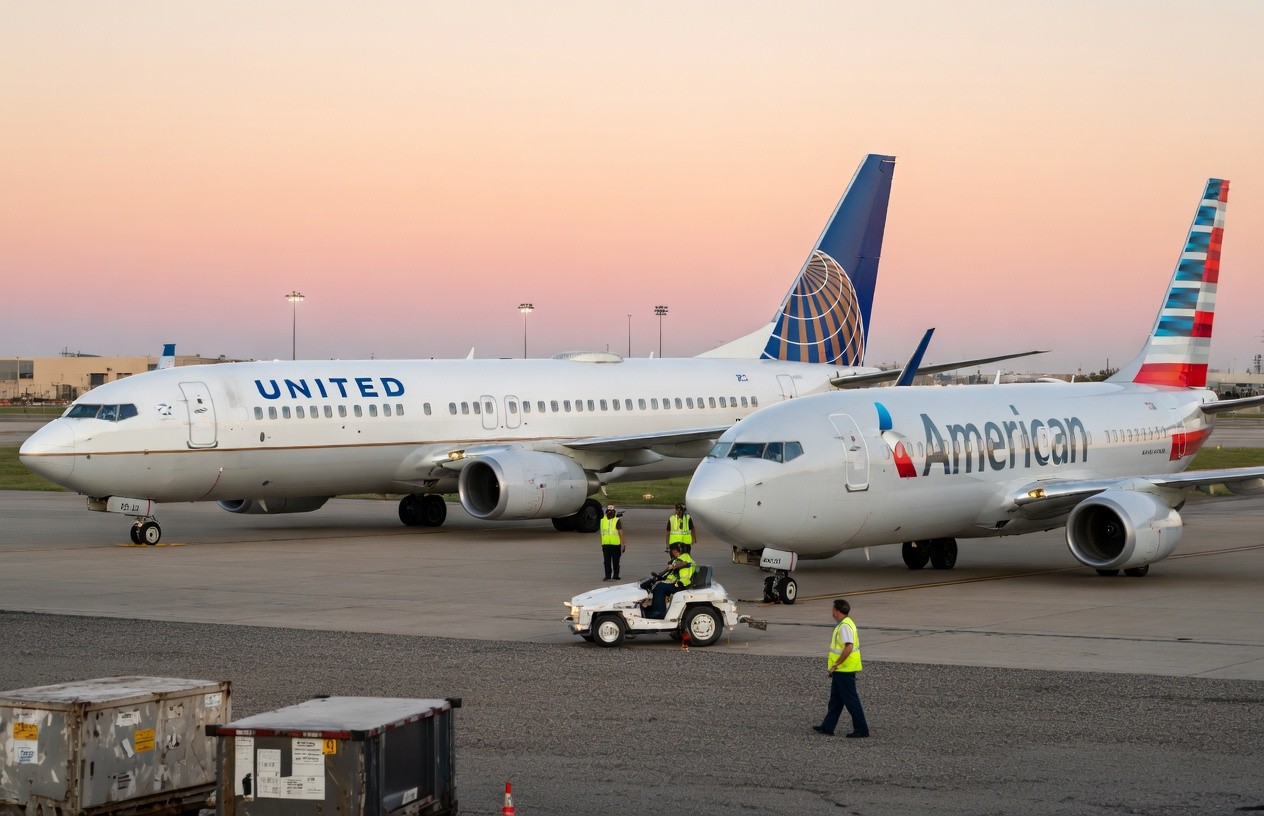
Recent reports suggest that United Airlines CEO Scott Kirby has approached the administration—reportedly even meeting with President Trump—to pitch an unprecedented move: the acquisition of American Airlines.
While such a merger would face massive antitrust hurdles and regulatory scrutiny, the proposal raises a fundamental question about the current state of the U.S. aviation industry. Is American Airlines suffering from a lack of resources, or is it suffering from a lack of vision?
The Identity Crisis at American Airlines
For much of the last decade, American Airlines has struggled with a fundamental strategic error. Rather than competing with premium carriers like Delta, American has largely attempted to compete on cost with ultra-low-cost carriers (ULCCs) like Spirit and Frontier.
This “race to the bottom” has had visible consequences for the passenger experience:
– Product Erosion: The removal of premium seating, the closure of airport clubs, and a general scaling back of “soft products” (amenities and service quality).
– Operational Friction: Struggles with reliability and technical infrastructure that have led to significant flight cancellations.
– Lack of Direction: A disconnect between leadership and frontline staff, leaving employees unsure whether they are providing premium service or budget transport.
The irony is that Scott Kirby himself once championed the idea of American becoming one of two premium global U.S. airlines. He eventually moved to United, where he successfully implemented that exact “premiumization” strategy.
How United Could Unlock American’s Potential
The argument for a takeover isn’t just about size; it is about operational synergy and strategic alignment. A United-led American could solve several critical pain points:
1. Rebuilding the Long-Haul Network
During the pandemic, American made the strategic blunder of retiring much of its widebody fleet (Airbus A330s, Boeing 767s, and 757s). With global supply chain constraints making new aircraft orders difficult, United—which has a robust widebody order book—could provide the hardware American needs to compete globally.
2. Elevating the Passenger Experience
United has moved beyond just adding “First Class” seats; they have invested in the entire cabin, including:
– Increased legroom in economy.
– Seatback entertainment.
– Improved food and beverage offerings.
3. Strategic Market Dominance
For United, acquiring American is a massive growth play. It would provide:
– A dominant presence in New York, Los Angeles, and Chicago.
– A much-needed hub in the Southeast.
– A massive expansion of its loyalty program footprint, particularly in high-spend markets like the Sun Belt.
The Risks: Monopoly and Loyalty Erosion
A merger of this scale is not without significant downsides for the traveling public.
The Competition Problem
Consolidation generally reduces competition, which can lead to higher fares. In the U.S. aviation market, high barriers to entry (airport slot constraints and airspace congestion) mean that a new competitor cannot simply “pop up” to fill the void left by a merged entity.
The Loyalty Dilemma
Currently, American’s AAdvantage program is often viewed as more generous than United’s MileagePlus. Under United, there is a risk that:
– Award availability could tighten.
– Redemption costs could rise.
– The “squeeze” on frequent flyers—a trend seen in United’s recent tactics—could be applied to American’s customer base.
Global Alliance Shifts
A merger would trigger a massive reshuffle in international alliances. American (part of oneworld ) would move to Star Alliance, fundamentally changing how passengers connect through partners like Lufthansa, Air Canada, and ANA.
Conclusion
A United-American merger would be a high-stakes gamble. While it offers a way to rescue American Airlines from a decade of identity crisis and underinvestment, it risks creating a dominant behemoth that could prioritize profit margins over passenger value and market competition.